Sending bulk mail to poorly consented or non-opted-in lists is one of the fastest ways to wreck an otherwise healthy sending domain, because it damages the very reputation signals that Gmail, Outlook and Yahoo use to decide whether your legitimate campaigns reach the inbox at all. The main culprits are weak or missing authentication, high bounce rates, complaint spikes and a domain that was never properly warmed up before volume arrived. If any of that sounds familiar, the fix is technical and behavioural, and it starts long before you touch a subject line.
TL;DR:
- Sending to poorly consented or scraped lists risks immediate reputation damage due to high complaint and bounce rates, which can take weeks to recover from.
- Properly aligning SPF, DKIM, and DMARC, along with choosing between shared or dedicated IPs, is essential for effective authentication and infrastructure security.
- Maintaining bounce rates below 2 percent and spam complaint rates under 0.1 percent is critical to avoid triggering filtering algorithms and domain suspension.
- Genuine personalisation and segmentation, based on recipient engagement and behaviour, significantly improve reply rates and protect brand trust.
- Conducting an email deliverability audit before campaigns helps identify technical flaws, rebuild reputation, and prevent avoidable job loss caused by unmanaged infrastructure issues.
Digistrat
Protect Your Email Sending Reputation
Digistrat assesses sender reputation, infrastructure, and list quality to help businesses address spam placement and declining email engagement.
Table of Contents
- Why cold email is a bad idea when it damages inbox placement
- Technical checklist: authentication, sending architecture and common infrastructure mistakes
- The metrics and thresholds that tell you when to act
- Step-by-step remediation and safer sending practice
- When to bring in a deliverability consultant
- Alternatives to cold emailing for outreach and lead generation
- Legal considerations: CAN-SPAM, GDPR and consent
- Why cold emails often fail on a human level
- What the evidence shows about cold email’s real-world performance
- Impact on brand reputation and trust
- Personalisation and segmentation that actually improve reception
- The gap between what cold outreach promises and what deliverability actually costs
- Start with an audit before your next campaign goes out
- Sources
- FAQ
Why cold email is a bad idea when it damages inbox placement
The mechanism is simple, even if the consequences are not. Every mailbox provider watches how recipients react to your mail, and when a meaningful share of them hit “report spam” instead of quietly deleting or ignoring an email, that provider starts routing more of your mail to the junk folder, then throttling your sending speed, then in serious cases blocking you outright.
This is the part that catches marketing and IT teams off guard: it does not take a huge volume of complaints to trigger a shift. A poorly targeted or non-consented send that irritates even a small percentage of recipients can move you from “trusted sender” to “watched sender” within a single campaign, and the providers do not tell you this is happening in real time.
List quality compounds the problem. Old, purchased or scraped lists are riddled with dead addresses and spam traps, addresses planted specifically to catch senders who are not managing consent or hygiene properly. Hit enough traps and the damage accelerates far faster than a simple bounce count would suggest.
What makes this genuinely painful for opted-in programmes is the recovery timeline. Reputation can collapse in the space of one badly judged send, but rebuilding it is measured in weeks, not hours. According to research on sender reputation, recovery from a reputation drop typically takes four to eight weeks of disciplined, careful sending.
- User-reported spam changes filtering algorithms almost immediately, not gradually
- Spam traps in old or purchased lists accelerate reputation damage disproportionately to their volume
- Reputation is per domain and per IP, so damage on one stream can bleed into others sharing the same infrastructure
- A single bad campaign can undo months of careful list building
Technical checklist: authentication, sending architecture and common infrastructure mistakes
Most deliverability failures trace back to the same handful of technical gaps, and they are almost always fixable once someone actually looks for them.
SPF, DKIM and DMARC need to work together, not just exist. SPF tells receiving servers which IPs are allowed to send on your behalf, DKIM cryptographically signs the message so it cannot be tampered with in transit, and DMARC tells the receiving server what to do if either check fails. Publishing all three without enforcing DMARC properly is a common half-measure that leaves you exposed. Once you move DMARC to a strict enforcement policy, any third-party tool sending on your domain without proper authentication will start bouncing, which is exactly the outcome you want, because unauthenticated senders are a liability you did not know you had. As Digistrat’s own guide to SPF, DKIM and DMARC explains, this is often where the real damage started.
Sending architecture matters just as much. Shared IPs mean you inherit the reputation, good or bad, of everyone else on that IP block, while dedicated IPs put you fully in control but require proper warmup before they carry any real volume. TLS should be enforced on every connection, and you need to be deliberate about which domain sends what: your primary corporate domain should rarely, if ever, carry higher-risk bulk traffic, with secondary domains absorbing that risk instead.
- Confirm SPF, DKIM and DMARC are all published and aligned, not just present
- Audit every third-party platform sending on your behalf against your DMARC policy
- Decide deliberately between shared and dedicated IPs based on volume and control needs
- Keep bulk or higher-risk sends off your primary corporate domain
Pro Tip: Before blaming your list, read the actual bounce error text. A surprising number of “bad list” bounces are really DMARC or SPF misconfigurations rejecting mail that was otherwise perfectly legitimate.
The metrics and thresholds that tell you when to act
Three numbers matter more than anything else in your ESP dashboard, and each has a clear point at which you should stop sending and start remediating.
- Bounce rate. Under 0.5% is excellent, 0.5% to 1% is good, 1% to 2% is a warning sign, 2% to 5% is dangerous, and anything above 5% is critical territory where you should pause the campaign and suppress hard bounces immediately, according to bounce rate benchmarks from Signet. Hard bounce rates sitting at or above 1% often point to genuine list health problems rather than one-off technical blips, a pattern HubSpot’s research on sender reputation also flags as a reliable early warning.
- Spam complaint rate. Aim to stay under 0.1%, because Gmail’s own sender guidelines treat anything above that threshold as harmful to inbox delivery, and rates at or above 0.3% cause materially worse damage. One-click unsubscribe should be honoured within 48 hours, no exceptions.
- Reply rate, not open rate. Open rate has become close to meaningless thanks to mail privacy protections that pre-load images regardless of whether a human opened the message. Reply rate is the signal worth watching, and a healthy cold B2B programme typically sits somewhere in the 5% to 12% range.
You are in “pause the campaign today” territory, because every additional send at that complaint level actively worsens the provider’s view of your domain.
Step-by-step remediation and safer sending practice
Fixing a damaged domain follows a fairly predictable sequence, and skipping steps is what turns a six-week recovery into a domain retirement.
- Triage immediately. Pause the riskiest segments first, isolate whichever list or source is generating the complaints or bounces, stop using any purchased or scraped lists outright, and suppress every hard bounce the moment it happens rather than batching the clean-up for later.
- Fix authentication properly. Implement SPF, DKIM and DMARC correctly rather than partially, and audit every platform, CRM plugin or marketing tool that sends on your behalf to confirm it is authenticated under your policy. Digistrat’s 90-day DMARC implementation plan sets out a realistic sequence for UK teams doing this properly rather than rushing it.
- Rebuild deliberately. Cool the domain back down to warmup-level volumes for 14 to 21 days, then ramp at roughly 50% per week rather than jumping straight back to full volume. If there is no meaningful recovery after four to six weeks of disciplined sending, retiring the domain and warming a fresh one is often the more pragmatic route.
- Bake in good operational habits. One-click unsubscribe, honouring opt-outs within 48 hours as Gmail recommends, segmenting aggressively for your most engaged recipients, and optimising every campaign for replies rather than opens.
Pro Tip: Warmup is not optional for a new domain, and it is not something you can compress by sending more aggressively. Skipping it is one of the most common causes of an immediate spam flag, and it is precisely the mistake that leads teams back to step one.
When to bring in a deliverability consultant
Certain signals mean in-house effort has reached its limit and outside expertise will save you more time than it costs. A blocklist listing, an ISP actively throttling your sending speed, a sudden spike in complaints you cannot trace to a single campaign, persistent bounce spikes that survive your own troubleshooting, or a failed recovery attempt after four to six weeks of disciplined sending are all reasonable triggers to call in help.
Realistic timelines run from a few days for forensic diagnosis to several weeks for full authentication remediation and warmup, with success measured against the concrete thresholds already covered here, not vague promises of “better deliverability.”
Alternatives to cold emailing for outreach and lead generation
If bulk sending to poorly consented lists is off the table, the realistic alternatives fall into a handful of categories that carry far less reputational risk.
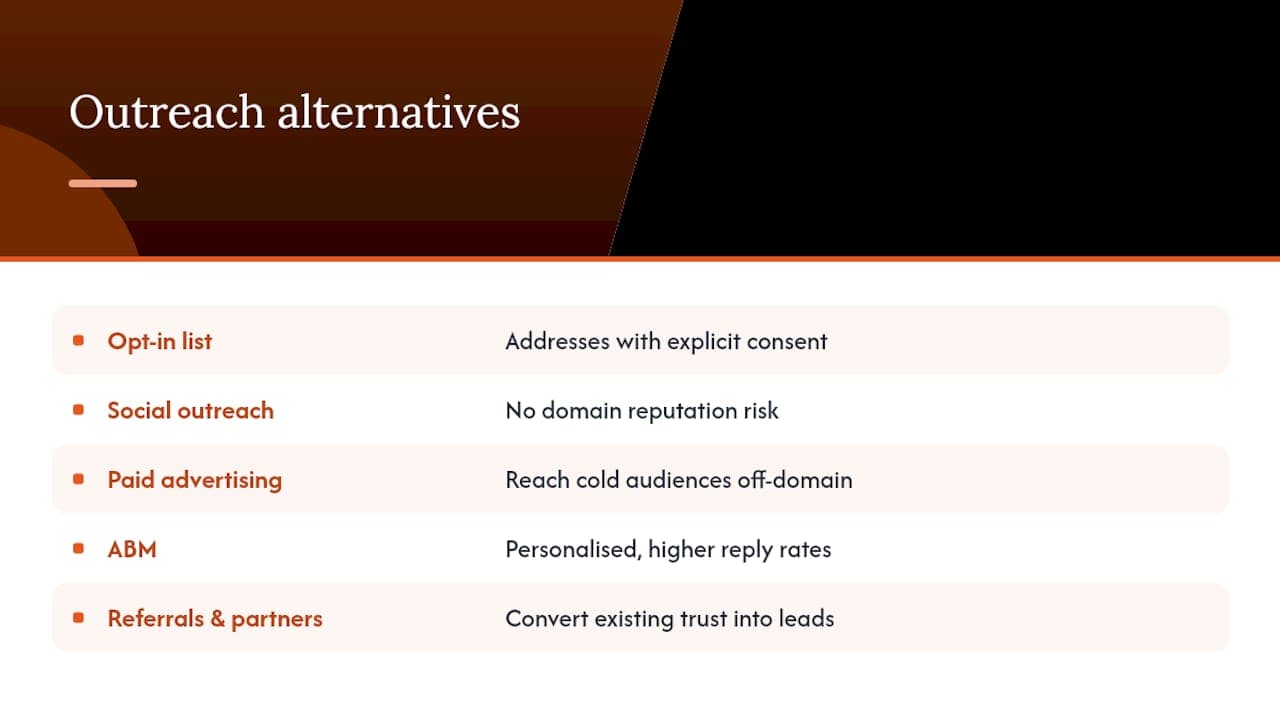
Building a genuinely opted-in list through gated content, webinars or product trials takes longer than buying a list, but every address arrives with actual consent attached, which is the single biggest predictor of long-term deliverability health. LinkedIn outreach and other social channels carry no domain reputation risk at all, because a rejected connection request does not follow you into your email infrastructure. Paid advertising and retargeting let you reach cold audiences without ever touching your sending domain’s reputation.
Account-based marketing, where a smaller number of well-researched, highly relevant messages replace mass sends, tends to produce far better reply rates precisely because the personalisation is genuine rather than templated. Referral and partner programmes convert existing trust into new leads instead of manufacturing cold interest from scratch. And when outreach by email is genuinely necessary, tools built specifically for message quality, such as AmmarAI’s cold email generator, focus on writing outreach that earns replies rather than triggering spam filters, which matters because the content itself is one of the levers that determines whether a message ever reaches a human eye.
None of these alternatives are a substitute for having a properly opted-in, well-maintained list in the first place, but they reduce your reliance on the riskiest form of outreach while you build one.
Legal considerations: CAN-SPAM, GDPR and consent
Compliance rules differ by jurisdiction, but the underlying principle is consistent: recipients need a genuine basis for receiving your mail, and that basis needs to be documented.
In the United States, the CAN-SPAM Act requires a clear identification of the sender, an honest subject line, a working physical address, and a functioning opt-out mechanism that gets honoured promptly. It does not require prior opt-in, which is part of why so much low-quality bulk mail originates from senders relying on CAN-SPAM as their only compliance bar.
For UK and European senders, the position is considerably stricter. The UK GDPR and the Privacy and Electronic Communications Regulations generally require a proper legal basis, most often explicit consent or a narrow legitimate interest exception, before you send marketing email to an individual. Sending to purchased or scraped lists without that basis is not just a deliverability risk, it is a compliance exposure that regulators can and do act on. For any business responsible for an opted-in programme, the safest practical position is to treat consent as a genuine record you can produce on request, not a box someone ticked once during a data import.
None of this article constitutes legal advice, and any business uncertain about its own compliance position should get advice from a qualified data protection professional rather than relying on general guidance.
Why cold emails often fail on a human level
Deliverability problems are not purely mechanical. They start with how a recipient reacts, in the moment, to an unexpected email from someone they do not know.
An email that arrives without prior context reads as an interruption, and most professionals have developed a fast, almost reflexive filter for exactly that kind of message. The moment a subject line or opening line signals “this is a template sent to hundreds of people,” the recipient’s trust in the sender drops before they have read a single further word. Genuine personalisation, referencing something specific and true about the recipient’s business, is one of the few things that reliably overrides that reflex, but it is expensive to do at scale, which is exactly why so much bulk outreach skips it and pays the reputational price instead.
There is also a compounding trust problem specific to brands with an existing reputation to protect. A recognisable company sending an obviously templated, unsolicited pitch does more damage to how that recipient perceives the brand than an unknown sender doing the same thing, because the recipient expected better. That mismatch between brand expectation and actual behaviour is where a lot of the “why did this backfire so badly” moments in cold outreach actually originate.
What the evidence shows about cold email’s real-world performance
The gap between how cold email is marketed and how it actually performs is stark once you look at the numbers seriously rather than anecdotally.
Healthy, well-targeted business-to-business programmes with genuine relevance and proper authentication typically land in the 80% to 95% primary inbox placement range, according to ReachIQ’s deliverability research.
That gap is the entire argument for treating cold outreach as high risk rather than a cheap volume play. A programme that looks identical on paper, same list size, same sending cadence, can produce wildly different commercial outcomes depending purely on whether the underlying reputation and authentication fundamentals are in place.
Impact on brand reputation and trust
The reputational cost of a poorly executed bulk send extends well beyond the inbox. A recipient who reports one unwanted email as spam does not just affect that single message, they form an impression of the sending organisation that colours how they respond to every future communication, including the opted-in newsletter they genuinely signed up for.
This matters enormously for larger organisations sending from a single corporate domain across multiple teams. Marketing’s carefully built opted-in programme can suffer collateral damage from a sales team’s unrelated bulk outreach if both share the same sending domain, because mailbox providers assess reputation at the domain level, not the campaign level. That is precisely why keeping higher-risk sending off your primary domain, as covered in the technical section above, is not just a deliverability tactic. It is brand protection.

Trust, once eroded through unwanted contact, is slow to rebuild and often never fully recovers with that specific recipient. The commercial cost shows up quietly, in falling engagement on the very campaigns your business actually depends on for revenue.
Personalisation and segmentation that actually improve reception
Genuine personalisation goes well beyond inserting a first name into a template, and the segmentation that supports it needs to happen before a single email is written, not after a campaign underperforms.
Segment by engagement history first: recipients who have opened, clicked or replied to previous campaigns deserve different treatment and different frequency than those who have gone quiet for six months. Segment by lifecycle stage second, because a message relevant to a brand-new subscriber rarely fits someone who has been a customer for two years. Behavioural triggers, such as a specific product viewed or a support ticket recently closed, produce far higher relevance than static demographic segments ever will.
Content-level personalisation matters just as much as list segmentation. Referencing something specific and verifiably true about the recipient’s business or role signals genuine research rather than automation, and that signal is precisely what determines whether a message earns a reply or a spam report. Combined with proper segmentation, this is the difference between a programme with the reply rates covered earlier in this article and one hovering near zero.
The gap between what cold outreach promises and what deliverability actually costs
Cold outreach gets sold on the promise of volume: send to enough people and the maths eventually works out. What that pitch consistently leaves out is that volume without consent and without infrastructure discipline is borrowing against a reputation you have not built yet, and mailbox providers collect on that debt faster than most teams expect.
The uncomfortable truth for a lot of organisations is that their deliverability problems were never really about the cold sends themselves. They were about a primary domain carrying too much risk across too many teams, authentication that was configured once in 2019 and never revisited, and a habit of treating bounce and complaint metrics as background noise rather than an early warning system. Fixing that is rarely glamorous work, and it is almost never the first thing a marketing team wants to hear when a campaign underperforms.
What actually works is unfashionable by comparison: proper authentication, deliberate warmup, aggressive suppression of bad addresses, and treating reply rate as the metric that matters. None of that photographs well in a case study, but it is the difference between a domain that recovers in six weeks and one that never fully does.
Start with an audit before your next campaign goes out
If any of the thresholds in this article sound uncomfortably close to your own dashboard, waiting for the next campaign to confirm the problem is the expensive option. Technical diagnostics services are available for exactly this situation, looking at authentication, sending architecture and reputation signals before you commit to another send that could make things worse.
A typical engagement starts with a deliverability audit that identifies precisely which of the technical or behavioural factors covered above are affecting your inbox placement, followed by authentication setup or remediation where SPF, DKIM or DMARC gaps are found. For businesses that have already been burned once, ongoing reputation monitoring catches the next problem before it reaches complaint-spike territory, and e-commerce or DTC senders dealing with seasonal volume swings can find guidance specific to their sending patterns as well. Book a diagnostic call to get a proper read on where your programme actually stands before your next campaign goes out.
Sources
For readers who want to verify the thresholds and standards referenced throughout this article, Gmail’s own sender guidelines are the primary source for spam complaint thresholds and unsubscribe requirements. Digistrat’s guide on complaint rates and the deliverability explainer cover the commercial mechanics in more depth.
- Email sender guidelines FAQ - Gmail Help
- Sender reputation: how to build and protect it in 2026
- Email Bounce Rate: Hard vs Soft Bounces, Benchmarks, and How to Fix Them — Signet
- Bounce rates help keep sender reputation healthy — HubSpot
FAQ
Why is cold email a bad idea for opted-in senders?
Because sending to poorly consented or purchased lists generates the bounces and complaints that damage the domain reputation your genuinely opted-in campaigns depend on, and recovery typically takes four to eight weeks.
What bounce rate should trigger action?
Anything above 2% is dangerous and above 5% is critical, according to bounce rate benchmarks; suppress hard bounces immediately rather than waiting for the batch report.
What spam complaint rate is considered safe?
Stay under 0.1%, since Gmail’s sender guidelines treat anything above that as harmful, with 0.3% or higher causing significantly worse damage.
Is open rate a reliable engagement metric for cold outreach?
No.
When should a business call in a deliverability consultancy?
When you hit a blocklist, face persistent ISP throttling, see a complaint spike you cannot trace, or fail to recover after four to six weeks of disciplined remediation. Digistrat’s audit service is built for exactly that point in the process.