Shared IPs suit low-volume or irregular senders because the reputation work is already done for you by the provider, while dedicated IPs make sense once you are sending high volumes of time-critical or compliance-bound mail and can commit to a warm-up plan and ongoing monitoring. The decisive factors are your send volume, how much operational capacity you have to manage reputation yourself, and whether a warm-up schedule is realistic given your sending cadence.
Table of Contents
- Shared vs dedicated IP: a snapshot comparison
- How shared and dedicated IPs work technically
- Deliverability impact: when volume actually justifies a dedicated IP
- Security, performance and SEO: separating myths from reality
- How to choose: a practical checklist
- What we see auditing UK and European senders
- How Digistrat can help you get IP strategy right
- Sources
- FAQ
Shared vs dedicated IP: a snapshot comparison
The practical differences between a shared and dedicated IP boil down to who controls reputation, how much it costs to run, and what kind of mail you are sending. On a shared IP, you inherit the collective sending history of everyone else using that address through your email service provider (ESP). That is either a benefit or a liability, depending on how well the ESP polices its pool. On a dedicated IP, your domain’s fate rests entirely on your own sending behaviour, with nobody else’s mistakes to blame and nobody else’s good habits to lean on.
- Reputation control: shared IPs pool reputation across many senders managed by the ESP; dedicated IPs isolate reputation to your organisation alone.
- Cost and overhead: shared IPs are typically included in ESP pricing tiers with no setup burden; dedicated IPs usually carry an additional monthly fee plus the internal time needed to monitor them.
- Typical use cases: shared IPs fit transactional mail, test environments and irregular campaigns; dedicated IPs fit sustained high-volume marketing and mission-critical transactional traffic.
- SSL and SEO myths: neither TLS certificates nor search rankings depend on which IP type you use, a point worth remembering before anyone tries to upsell you a dedicated IP for either reason.
If your sending pattern is inconsistent, a shared IP is generally the pragmatic default, and it removes a layer of operational risk that many smaller marketing teams simply do not have the resource to manage.
How shared and dedicated IPs work technically
Every domain you send from is mapped to an IP address through DNS records, and there is nothing stopping dozens or even thousands of unrelated domains from resolving to the same IP simultaneously. That is precisely how shared hosting and shared ESP pools function: one server, one address, many tenants. Mailbox providers such as Gmail and Outlook do not evaluate your domain in isolation. They watch the behaviour of the IP itself, cross-referencing it against domain-level signals like your SPF, DKIM and DMARC records, engagement rates, and complaint history.
On a shared IP, that behaviour is a blend of everyone sending through it. A well-run ESP actively curates who gets access to its pools, removing bad actors before they contaminate the shared reputation, which is why ESP-managed pools reduce your operational burden considerably compared with running your own infrastructure. You benefit from infrastructure that has already been warmed and vetted long before your first campaign goes out.
A dedicated IP starts from nothing. Mailbox providers have no history to judge you by, so a brand new dedicated IP without a warm-up plan tends to get throttled or filtered straight to spam. Warm-up means increasing your daily volume gradually, typically over two to four weeks, while keeping your cadence consistent so the sending pattern looks predictable rather than erratic. A dedicated IP genuinely does require this warm-up process, and shared IPs need far less onboarding effort by comparison because the reputation groundwork already exists. Skip the warm-up and you are effectively asking Gmail to trust a stranger with your entire inbox strategy on day one, which rarely ends well.
Deliverability impact: when volume actually justifies a dedicated IP
Poor IP reputation is the single fastest route to the spam folder, and it compounds quickly. Once complaint rates or spam-trap hits push an IP onto a blocklist maintained by organisations such as Spamhaus, mailbox providers start filtering or rejecting mail from that address wholesale, sometimes within hours of the trigger event. On a shared IP, this is rare because the ESP is actively watching for exactly this pattern and removing offenders. On a dedicated IP, you are the only line of defence, and a single badly targeted campaign can do real damage to inbox placement that takes weeks to repair.
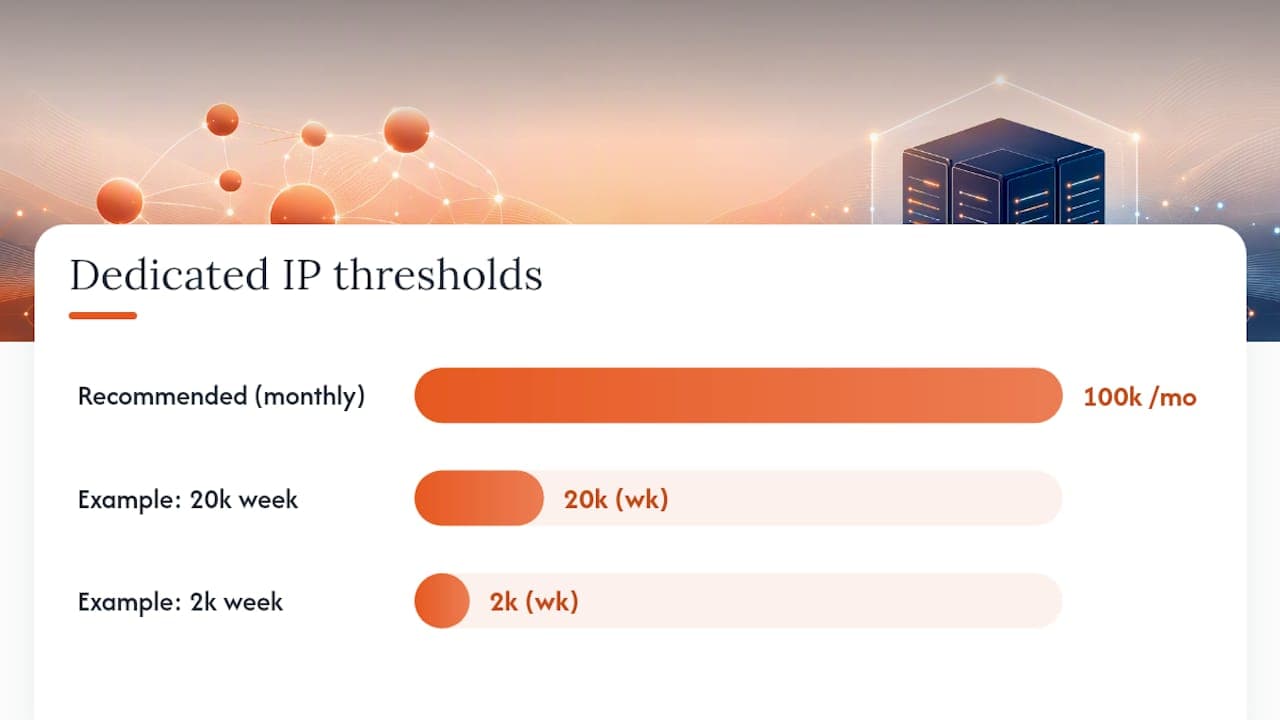
The most consistent guidance across the industry is that dedicated IPs earn their keep once you are sending high volumes of critical transactional or time-sensitive mail, not before. Most providers advise holding off until you can sustain roughly 100,000 sends a month with genuine consistency, because the reputation-building burden of a dedicated IP outweighs its benefits unless volume and cadence are already stable. Sending 20,000 emails one week and 2,000 the next is exactly the kind of erratic pattern that makes a fresh dedicated IP struggle.
Recommended warm-up cadence: start at a low daily volume, favour your most engaged subscribers first, and double volume roughly every three to five days over two to four weeks rather than jumping straight to full send volume.
Once live, watch these metrics closely:
- Bounce rate: stay under 2% for a healthy list; anything above 5% signals a hygiene problem.
- Complaint rate: keep below 0.1%; sustained complaints above this level will trigger filtering at most major mailbox providers.
- Engagement rate: falling open or click rates on a dedicated IP are an early warning sign long before blocklisting occurs.
Pro Tip: Segment your warm-up sends by engagement history rather than list size. Sending first to subscribers who opened your last three campaigns builds reputation faster than blasting your entire list on day one.
It is worth remembering that IP reputation is only one input into deliverability; authentication records and list hygiene carry just as much weight, and a dedicated IP will not rescue a poorly authenticated domain sending to a stale list. For a fuller picture of how those pieces interact, our guide to sending architecture and authentication covers the mechanics in more depth.
Security, performance and SEO: separating myths from reality
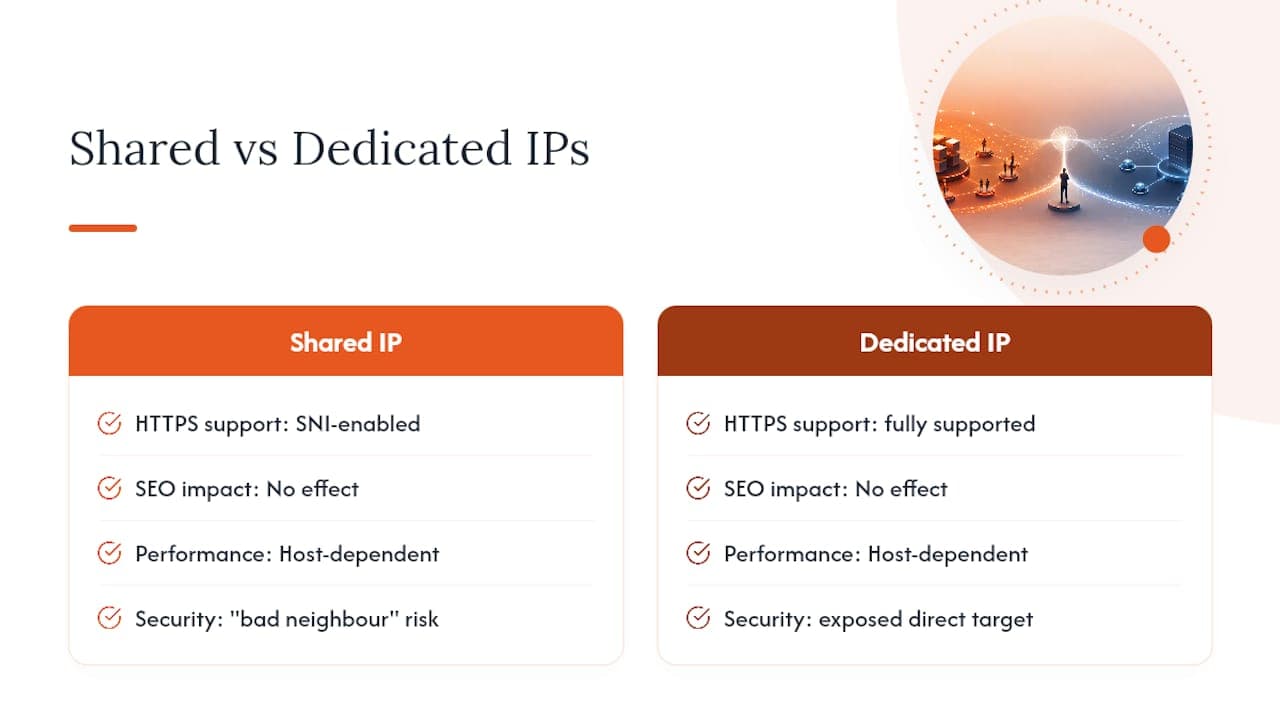
A persistent myth is that you need a dedicated IP to run SSL. That was true many years ago, but it stopped being true once Server Name Indication (SNI) became standard practice across modern browsers and servers. SNI allows multiple domains on a shared IP to each present their own SSL certificate, which means buying a dedicated IP purely to enable HTTPS is money spent solving a problem that no longer exists.
The same applies to search rankings. Google has never confirmed IP type as a ranking factor, and site performance depends far more on hosting architecture, server response time and content delivery than on whether your IP is shared or exclusive. If your site is slow, the fix is usually better caching or a faster host, not a new IP address.
Where dedicated IPs do carry a genuine trade-off is security exposure. A dedicated IP is fully isolated from other tenants’ reputations, which removes the bad neighbour risk that shared hosting can create, but it also means attackers know exactly which address to target if they want to hit your infrastructure directly. The sensible mitigation is putting a reverse proxy, CDN or web application firewall (WAF) in front of the origin. Hiding the origin behind a reverse proxy or CDN significantly reduces direct-to-IP attack risk while preserving the reputational benefits of a dedicated address, giving you isolation without leaving the front door wide open.
How to choose: a practical checklist
Working through a short decision framework beats guessing, and it forces you to confront the operational realities rather than the sales pitch. Before committing either way, answer these questions honestly.
- What is your actual monthly send volume, and how consistent is it week to week? Irregular volume under roughly 100,000 sends a month rarely justifies the warm-up effort a dedicated IP demands.
- How critical is the mail itself? Password resets, invoices and order confirmations landing late or in spam cost you support tickets and revenue; a promotional newsletter arriving an hour late does not.
- What is your budget, including the internal time to monitor reputation, not just the IP fee itself?
- Do you have someone who can watch bounce, complaint and engagement metrics weekly? A dedicated IP left unmonitored is worse than a well-managed shared one.
- Do you need IP whitelisting for a specific enterprise recipient, such as a bank or government body? That requirement alone can justify a dedicated IP regardless of volume.
Ask your ESP or host directly: what warm-up support do they provide, how do they monitor IP reputation on your behalf, and what is their actual response time if you land on a blocklist. Vague answers to any of those three questions are a red flag. So is a host offering a dedicated IP with no mention of warm-up guidance at all, since that usually means you are on your own the moment reputation problems start. Our guide on fixing deliverability issues walks through the monitoring routine in more detail, and providers such as HarbourSide Digital list managed hosting packages that bundle dedicated IPs as standard, which is worth checking before you buy one separately.
What we see auditing UK and European senders
Across the audits Digistrat has run for UK and European senders, the same handful of misconfigurations turn up repeatedly regardless of whether the client is on a shared or dedicated IP. Missing or partially configured SPF, DKIM and DMARC records are the most common finding, often alongside sending cadence that swings wildly from week to week, which undermines reputation on either IP type. Poor list hygiene, stale addresses that have not opened mail in over a year, sits quietly in the background making every other problem worse.
The commercial cost is rarely abstract. We have seen order confirmations and invoices silently filtered to spam, generating support tickets and delaying payment, and abandoned cart sequences that never landed because a client moved to a dedicated IP without a warm-up plan. Choosing the right IP strategy matters, but it only pays off alongside proper authentication and list management. That combination, not the IP decision alone, is usually what separates senders who recover their inbox rates from those who keep guessing.
— James
How Digistrat can help you get IP strategy right
Deciding between shared and dedicated is only half the job; getting the warm-up plan, authentication and ongoing monitoring right is what actually protects your inbox placement afterwards. Digistrat runs a full email deliverability audit that checks your IP setup, authentication records and list quality together, rather than treating IP choice as an isolated decision, so you get a single clear answer about what is actually costing you inbox placement.

If a dedicated IP is genuinely the right move for your volume, Digistrat supports the warm-up process itself and provides ongoing reputation monitoring once you are live, catching bounce or complaint spikes before they turn into a blocklisting incident. The outcome clients consistently see is higher inbox placement and fewer support tickets from customers chasing invoices or order confirmations that never arrived. If you want a clear, evidence-based answer for your own sending pattern rather than a guess, book a deliverability advisory session and we will walk through your specific volume, cadence and infrastructure together.
Sources
- Dedicated vs. Shared IP: Which is Right For Your Emails?
- Shared vs dedicated IP
- Dedicated IP vs. Shared IP: Which One Does Your Site Need?
FAQ
Is my IP shared or dedicated?
Check your ESP or hosting dashboard, which typically states the IP type under sending or server settings; if you have never paid extra for an IP address, you are almost certainly on a shared one.
Is it better to have a dedicated IP address?
Only if you send high volumes of consistent, critical mail and can manage warm-up and monitoring yourself; for low or irregular senders, a shared IP is usually the more practical choice.
What are the four types of IP addresses?
The common categories are public, private, static and dynamic addresses; shared and dedicated describe how an IP within these categories is allocated among users, not a separate classification system.
Should an IP address be shared?
For most low-volume or inconsistent senders, yes, since shared IPs are pre-warmed and actively managed by the ESP, which removes reputation-management work you would otherwise have to do yourself.