Email is not dying. It is maturing, which is a very different thing: the UK figures on usage, consumer preference and return on investment all point to a channel that is still central to how people work, buy and sign up for things, while the real pressure has moved from “will anyone read email?” to “will your email actually reach the inbox?”. This article looks at who still uses email, what might replace it, what the marketing numbers say, and what the shift means if you are responsible for revenue that depends on messages being delivered.
Table of Contents
- Why people keep saying email is dying
- Does anyone still use email?
- Will anything replace email?
- What the marketing numbers say
- What is actually changing
- Why this matters if you run lifecycle, CRM or engineering
- How to tell whether email is working for you
- Where Digistrat fits
- The sensible way to think about email’s future
- FAQ
- Sources
Why people keep saying email is dying
The claim is old and it keeps coming back for understandable reasons. Email carries spam, it is not real time, attachments are awkward, and a younger generation of workers has grown up with chat apps where a reply arrives in seconds. Every new collaboration tool arrives with a promise to make the inbox obsolete, and every few years a headline declares that a particular year will be the one we say goodbye to it.
The pattern is worth noticing, because it tells you something about the question itself. People complain about email precisely because they use it constantly. A channel that nobody relied on would not attract this much irritation, and an article from The Conversation made the same point years ago: email may be boring and long-established, yet there is no evidence it is going anywhere soon. A decade on, that still holds.
There is also a difference between email feeling worse and email being used less. Inboxes have become noisier, and people are less patient with irrelevant messages. That is a real change, but it is a change in what recipients tolerate, not in whether they have an inbox. For senders, the distinction matters enormously, and we will come back to it.
Does anyone still use email?
Yes, and in very large numbers. The Office for National Statistics reported that 86% of adults in Great Britain used email, making it the most common internet activity it measured, ahead of instant messaging at 72%. That data is from 2019, so treat it as the baseline rather than the current figure, but nothing since suggests a collapse.
More recent evidence comes from Ofcom, whose Online Nations report 2025 found that 58% of UK online adults used Gmail in May 2025, which remains the leading online email service. Those are people who have an address, check it and receive mail there, and many more use Outlook, iCloud and other providers on top of that.
The workplace picture is similar. The Exclaimer State of Business Email Report 2025 found that 81% of UK IT leaders named email as the most important channel for business-critical communication, and 48% of the IT leaders surveyed said they rely on direct email for more than half of their internal and external business communication. Exclaimer’s own reading of the data is that email persists because it works as a common layer when other tools are fragmented, and because it suits information that has to be seen, saved, shared, structured or audited, while instant messaging suits speed.
Generational habits do differ. A Guardian report from 2023 covered the view that younger workers lean towards chat at work. It is a fair observation about how some people prefer to talk to colleagues, but it describes a supplement to email, not a substitute, because those same workers still need an email address to sign up for almost everything else.

Will anything replace email?
Probably not as a universal replacement. The ICAEW has looked at this directly and concluded that email is not going to go away completely, while messaging apps and workflow, project-management and collaboration platforms are challenging it. Tools such as Microsoft Teams and Slack are built for project collaboration and can take over a good share of the back-and-forth that used to clog an inbox.
There is a structural reason replacement is so hard. The Guardian’s technology Q&A pointed out that most websites, cloud services and some operating systems use an email address as the account identifier, and that everyone has one or can get one easily. Until something else becomes a universal, open, cross-provider identity, email keeps doing a job that chat apps cannot, because chat apps are closed ecosystems and email is not.
It helps to separate what email is good at from what it is not:
| Job | Where it tends to live | Why |
|---|---|---|
| Quick internal questions | Chat tools | Speed and informality matter more than a record |
| Project updates and files | Collaboration and project platforms | Context stays attached to the work |
| Formal, auditable communication | It is portable, searchable and easy to retain | |
| Account sign-up, password resets, receipts | The address is the identity | |
| Customer marketing and lifecycle messaging | Email, alongside SMS and push | Consumers say they prefer it for brand communication |
The same pattern shows up in the public sector. The government’s own messaging service, GOV.UK Notify, reports on its performance page that it has sent 8.0 billion emails and 5.7 billion text messages since May 2016, across 1,764 organisations and 12,909 services. That is an operational system for things like confirmations and reminders, and email still carries the larger share.
What the marketing numbers say
If email were fading, you would expect marketers to be drifting away from it. The opposite is true. According to the DMA’s Marketer Email Tracker 2026, email accounts for a fifth of marketing budgets and returns £40.96 for every £1 spent, and between 74% and 83% of UK marketers use it across the customer journey, including pre-purchase, post-purchase and customer service. For retail teams in particular, a look at email marketing for ecommerce brands shows how that spread across the journey plays out in practice.
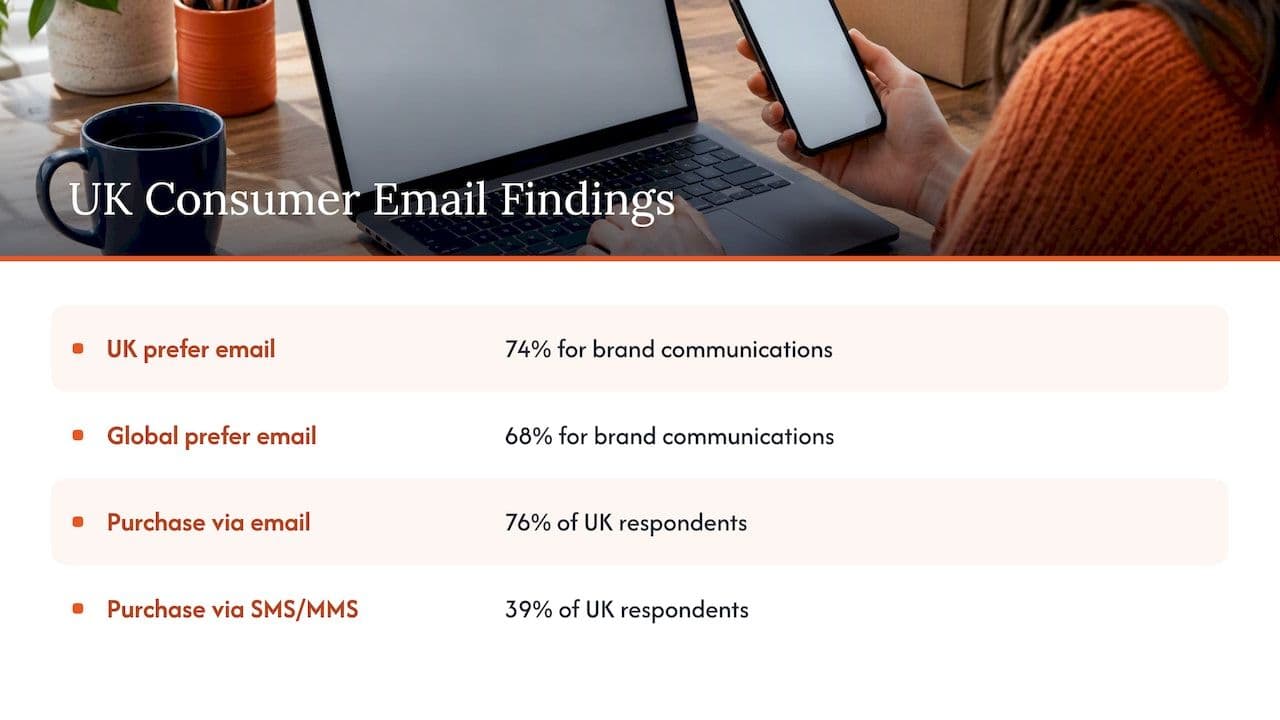
The consumer side backs it up. A 2024 Twilio report on UK email behaviour found that 74% of UK recipients prefer email for brand communications over SMS, voice or social media, higher than the global average of 68%, and that 76% of UK respondents had made a purchase based on email content, against 39% for SMS or MMS.
The delivery and engagement benchmarks are healthy too. The DMA’s Email Benchmarking Report 2025 recorded UK delivery rates of 98% in 2024, with B2C reaching 99.2%, and open rates rising to 35.9%. One caution on that last number: open rates are a soft metric, because privacy features and security tools can trigger or block tracking pixels, so clicks, conversions and revenue per send are a safer guide to whether your programme is working.
What the data does not say is that everything is easy. A delivery rate of 98% means the message was accepted by the receiving server, which is not the same as landing in the inbox rather than the spam folder or a promotions tab. That gap between accepted and seen is where most of the commercial damage happens, and it is where the real conversation about the future of email begins.
What is actually changing
Email is not dying, but the rules of the inbox are tightening, and some senders have been caught out. Three shifts matter most for UK and European businesses.
Stricter mailbox provider rules
From 1 February 2024, Google’s email sender guidelines require everyone sending to Gmail accounts to authenticate with SPF or DKIM, have valid DNS records, use TLS and keep spam rates below 0.3%. Anyone sending more than 5,000 messages a day to Gmail needs SPF, DKIM and DMARC, with alignment between the visible From domain and the authenticated domain, plus one-click unsubscribe on marketing and subscribed messages. Google also recommends keeping spam rates below 0.10% and avoiding 0.30% or higher, and notes that frequent spam reports make future messages more likely to be marked as spam and can lower domain reputation.
The practical meaning is simple. A sender who ignored authentication in 2021 could often get away with it, and in 2026 the same sender may find mail quietly discarded or filed under junk without any obvious error. GOV.UK’s guidance on Sender Policy Framework explains the basic mechanism: SPF publishes the domains or IP addresses allowed to send for you in DNS, so receiving services can treat mail from anywhere else as suspect.
Crowded inboxes and tired recipients
Even correctly authenticated email has to earn attention. Mailjet’s 2024 engagement survey found that 73% of respondents estimated receiving more than 10 emails on a typical day, that nearly half opened only a few brand emails a day and 8% opened none, and that close to 20% commonly unsubscribed because a brand sent too many messages. Low engagement feeds back into reputation, because mailbox providers watch how people behave towards your mail and adjust where it lands.
BCG has set out three causes of inbox failure: large volumes that trigger spam filters and harm sender reputation, outdated or unverified lists that increase bounces, and one-size-fits-all content that reduces engagement. None of those is about the channel being obsolete. All of them are about senders behaving in ways that modern filters punish.
AI between you and the reader
The DMA’s tracker also warns that the inbox is changing as AI-based triage tools and consumer AI agents begin to interpret, and potentially act on, email on the recipient’s behalf, shifting the focus from persuading a human to being relevant to an algorithm. If you want more detail on how that connects to sending practice, we have written about how AI is used in email and what it does to deliverability.
Why this matters if you run lifecycle, CRM or engineering
When people ask whether email is dying, they are often really asking whether the money and effort they put into it will keep paying off. The honest answer is that it will, provided the messages arrive. The risk to a SaaS onboarding sequence, an ecommerce abandoned-basket flow or a fintech verification email is rarely that the channel disappears. It is far more likely to be one of the following:
- A marketing platform and a transactional platform sending from the same domain, so a reputation problem on one drags down the other.
- Several lifecycle triggers firing at once, so a new customer receives four messages in an hour and starts marking them as spam.
- An old, unmaintained list that produces bounces and spam traps and quietly damages the domain.
- DMARC set to monitor only, or SPF records that have grown past their lookup limit after years of adding tools.
- A sudden volume jump after a migration or campaign, with no warm-up, that makes a previously fine sender look suspicious.
The symptoms look like a dying channel: open rates sag, revenue from flows slips, support tickets mention missing password resets. The cause is usually something fixable. A useful first step is to check what your sending platform is not telling you, which is why we describe what email deliverability monitoring actually looks like in practice, and why a specialist review tends to look well beyond authentication and blocklists.
If you are not sure whether your problem is technical, behavioural or a mix, what a deliverability consultant actually checks is a good way to see the shape of an investigation before committing to one.
How to tell whether email is working for you
Because open rates are unreliable, it pays to build a small set of measures that reflect whether mail is arriving and being acted on. The ones we find most useful are these:
- Spam complaint rate in Google Postmaster Tools, kept well under the thresholds Google publishes.
- Bounce rate by source, so you can see whether a particular list, form or integration is the culprit.
- Clicks and conversions per delivered message, compared with your own internal baselines rather than generic industry averages.
- Inbox placement by mailbox provider, ideally tested with seed addresses at regular intervals, because Gmail, Outlook and Yahoo can behave very differently for the same send.
- Authentication pass rates across every system that sends in your name, including the ones marketing set up and engineering never heard about.
That emphasis on your own baselines echoes e-shot’s UK benchmark commentary, which argues that effectiveness is better judged against internal baselines and the specific outcomes email drives, such as registrations and bookings, than against headline averages. A generic benchmark can tell you roughly where the market sits, but it cannot tell you whether your transactional mail is being delayed or your welcome series is landing in promotions.
A rising complaint rate or a slow slide in Gmail placement is also easier to deal with early. Reputation damage is cheaper to prevent than to recover from, and the longer a poor pattern continues, the more mailbox providers learn to expect it from your domain.
Where Digistrat fits
We are a UK-based email deliverability consultancy working with growth-stage SaaS, ecommerce and fintech teams in the UK and Europe, where email drives revenue, retention or activation. You work directly with a senior consultant who investigates why marketing, transactional and lifecycle emails are missing the inbox, looking at authentication, infrastructure and sender reputation alongside list quality, sending behaviour and overlapping lifecycle triggers, and then implements the agreed fixes with your team inside your own platforms.
A sensible way in is our free health check and 15-minute inbox check-up call, which help you see where to start. From there, Deliverability Review and Fix combines a detailed investigation with 45 days of implementation support, and Managed Deliverability adds daily monitoring, incident response, monthly inbox placement testing and one agreed strategic improvement each month. We also handle ESP migrations, IP and domain warm-up, authentication setup and reputation recovery.
If you have a specific question rather than a full investigation, a 90-minute advisory session is available for £250 one-off. You can book a free email deliverability check-up, look through all of our deliverability services, or read about the advisory session first. For teams that want a broader grounding in the subject before talking to anyone, this email deliverability guide covers the fundamentals of reaching the inbox.
The sensible way to think about email’s future
The most defensible view of the evidence is that email is settling into a stable, central role rather than fading. Slack’s own writing acknowledges that email’s importance at work is being eroded by more streamlined collaboration tools, yet describes it as a low-bandwidth constant that will probably never be fully replaced, and even Gorgias research on customer support suggests chat growth tends to come at the expense of social direct messages rather than email. Different vendors, selling different things, keep arriving at the same place.
For a business, that leads to a few practical conclusions. Treat email as infrastructure that needs an owner, not as a campaign tool that needs a calendar. Expect the technical bar to keep rising, because mailbox providers have shown they will enforce it. Measure outcomes you can trust, and watch the inbox itself, since AI triage will make relevance and good sending behaviour more important, not less. And keep other channels in the mix, because SMS, push and in-app messaging work well beside email, they do not remove the need for it.
FAQ
Is email becoming outdated?
It is becoming less fashionable for quick internal chat, but not outdated. ONS data showed email as the most common internet activity in Great Britain, and 81% of UK IT leaders surveyed by Exclaimer in 2025 named it as the most important channel for business-critical communication. Its role is narrowing towards formal, saved and auditable communication, and that is a role it does very well.
Will anything replace email?
No single tool looks likely to. The ICAEW expects messaging and collaboration platforms to replace some conversations, but email addresses are used as account identifiers across most websites and cloud services, which keeps email embedded in everything else. A more likely future is a mix of tools, with email as the dependable common layer.
Does anyone use email anymore?
Yes, in very large numbers. Ofcom found that 58% of UK online adults used Gmail in May 2025, and that excludes people using other providers. Younger workers may prefer chat for colleagues, but they still use email for accounts, receipts, applications and brand relationships.
Is email marketing dead?
No. The DMA reports that UK email marketing returns £40.96 for every £1 spent and takes a fifth of marketing budgets. What has changed is the standard senders must meet to reach the inbox, so authentication, list hygiene and sensible sending patterns now decide how much of that return you actually capture.
Why are my emails going to spam if email still works?
Usually because of something specific rather than anything about the channel. Missing or misaligned authentication, high complaint rates, stale lists, sudden volume changes and overlapping triggers are the common causes, and each can be diagnosed and fixed. A health check is the quickest way to find out which applies to you.
Sources
- Not dead yet: how email has survived and continues to thrive (The Conversation)
- Internet access, households and individuals, Great Britain (ONS)
- Online Nations report 2025 (Ofcom)
- The State of Business Email 2025 (Exclaimer)
- Gen Z workers and chat versus email (The Guardian)
- Will messaging apps replace email? (ICAEW)
- Is there a replacement for email? (The Guardian)
- Performance data (GOV.UK Notify)
- Marketer Email Tracker 2026 (DMA)
- UK Email Trends: How Consumers Engage in 2024 (Twilio)
- Email Benchmarking Report 2025 (DMA)
- Email sender guidelines (Gmail Help)
- Using Sender Policy Framework (SPF) in your organisation (GOV.UK)
- The Path to Email Engagement 2024 (Mailjet)
- Why Emails Aren’t Reaching Inboxes (BCG)